
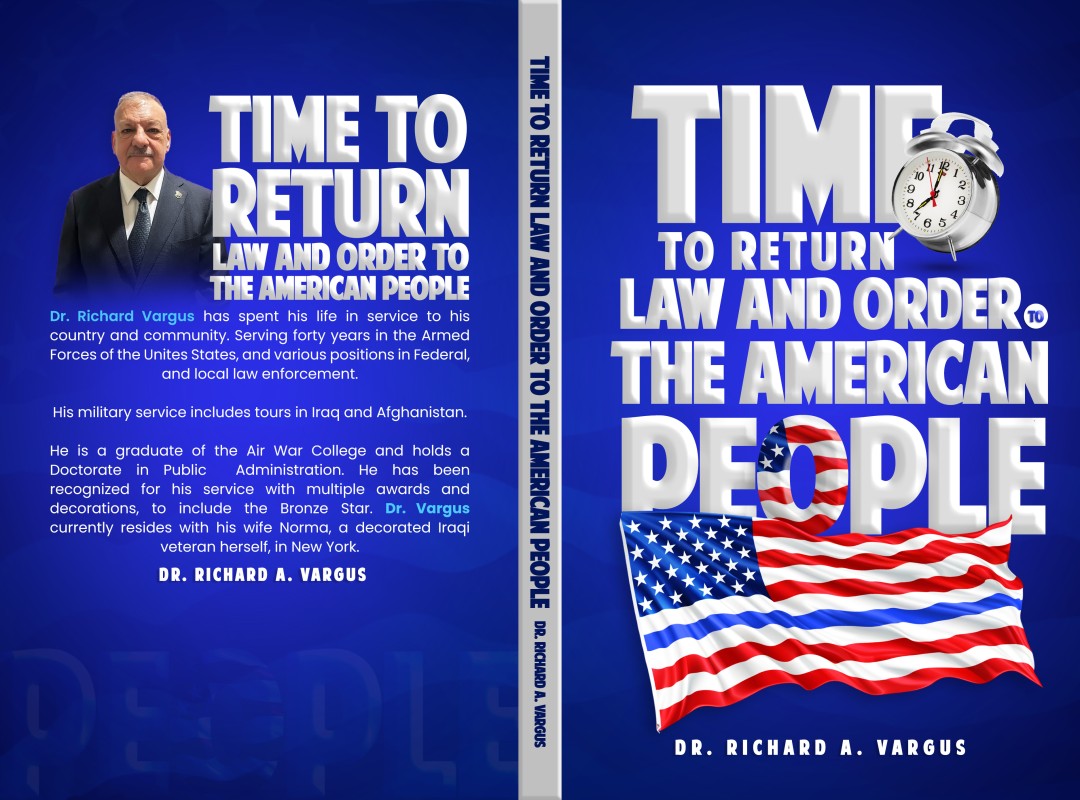
Fort Smith, Arkansas - Times to Return Law and Order to the American People, a new book by Dr. Richard A. Vargus, delivers a blunt warning: America is turning its back on policing strategies that once drove violent crime to historic lows. Drawing on decades in law enforcement and a doctorate in Public Administration, Vargus argues that political agendas, not community safety, now dictate how officers are allowed to do their jobs.
“Crime went down when we let police do the job the law actually allows,” Vargus says. “Crime went back up when politicians decided they knew more about the streets than the people who patrol them.”A Hard Look At What Worked – And Why It Was Abandoned
At the heart of the book is a simple claim: the combination of Broken Windows policing, Stop, Question and Frisk (SQF), and data-driven tools like CompStat helped produce the “Great American Crime Decline” from the 1990s through the early 2010s.
Vargus walks readers through how New York City and other major departments used disorder policing, quality-of-life enforcement, and SQF to take guns off the streets and push murders, robberies and car thefts down by staggering percentages.
“People forget what the 1980s and early 90s really looked like,” he writes. “You couldn’t pretend crime was a debate topic. It was on your doorstep.”
But Times to Return Law and Order doesn’t stop at celebration. It tracks how, over time, SQF shifted from a targeted tool at street level into a crude quota system driven by political demands and headline optics. That shift, he argues, damaged community trust and handed opponents an easy target.
Inside The Stop, Question And Frisk Debate
One core section of the book digs into the controversy around SQF and race. Vargus does something unusual here: he evaluates SQF through the eyes of minority officers who worked through the full life cycle of the policy in New York.
According to his research, those officers believed SQF searches based on reasonable suspicion were effective in reducing violent crime. The breakdown, they say, came when political pressure turned the practice into a numbers game.
“Stop, Question and Frisk worked as a scalpel,” Vargus notes. “It failed when it was turned into a hammer.”
He presents the NYPD crime data and the national Uniform Crime Reports with civil liberties reports that clearly point out the unequal stops of Black and Latino people. Instead of acting like one side has no faults, he compels the audience to face a more difficult reality: violent crime does indeed occur predominantly in certain areas and harsh policing was a major cause of discontent there.
CompStat, DEI And The Politics Of Crime Statistics
Another major thread in Times to Return Law and Order is the rise and fall of CompStat. Initially introduced as a neutral crime-mapping and accountability tool, CompStat became, in Vargus’ telling, both a powerful engine for crime reduction and a political pressure cooker inside the department. Precinct commanders were grilled over numbers, UF-250 stop forms became performance metrics, and the line between smart targeting and pure volume blurred.
“CompStat itself isn’t racist, partisan or emotional,” Vargus writes. “The way people use it can be all three.”
The book then moves to a sharp critique of modern Diversity, Equity and Inclusion agendas and defund-the-police campaigns. Vargus argues these projects have done little to improve conditions in underrepresented communities while tying the hands of officers and lowering standards inside departments.
He doesn’t mince words:
“Changing the colour of the uniformed faces on the street means nothing if you don’t change the reality of the streets themselves,” he says. “Representation without results is just another broken promise.”
A Country On Notice – And A Call To Citizens
The closing chapters link historic case studies – Rodney King, Amadou Diallo, Freddie Gray, Eric Garner, George Floyd – with what Vargus sees as a new era of anarchy: surging juvenile violence, fentanyl deaths, migrant-driven strain on services, and “catch and release” prosecution policies.
He lays responsibility squarely at the feet of political leadership, especially in major urban centres, but he doesn’t let the public off the hook. The core message is that “We the People” have tolerated policies that prioritise ideology over safety.
“Our cities did not collapse in a vacuum,” Vargus writes. “They collapsed because voters kept rewarding the same failed ideas.”
Times to Return Law and Order to the American People is part history, part policy analysis, part rallying cry. It is written for citizens who sense something has gone badly wrong with public safety and want to understand how policing once turned a corner – and what it would take to do it again.
About the Author
Dr. Richard A. Vargus is a career law enforcement veteran who served alongside officers in some of America’s most challenging environments. In 2019, he got his Doctorate in Public Administration and concentrated on the minority police officers' views of Stop, Question and Frisk during its peak years in New York City for his dissertation. His experience in the field together with his academic research brings him a unique view of the intersection of law, policy, politics, and policing. The book, Times to Return Law and Order to the American People is his newest venture to move the argument back to truth, history, and the actual life of the communities that suffer the most from violent crime.
Facebook:
https://www.facebook.com/RichardAVargus/
LinkedIn:
https://www.linkedin.com/company/richard-a-vargus
YouTube:
https://www.youtube.com/@RichardA.Vargus
Instagram:
https://www.instagram.com/richardavargus/
Media Contact
Company Name: Book Writers Hub
Contact Person: Rich Vargus
Email: Send Email
Country: United States
Website: https://livefortheblue.com/