
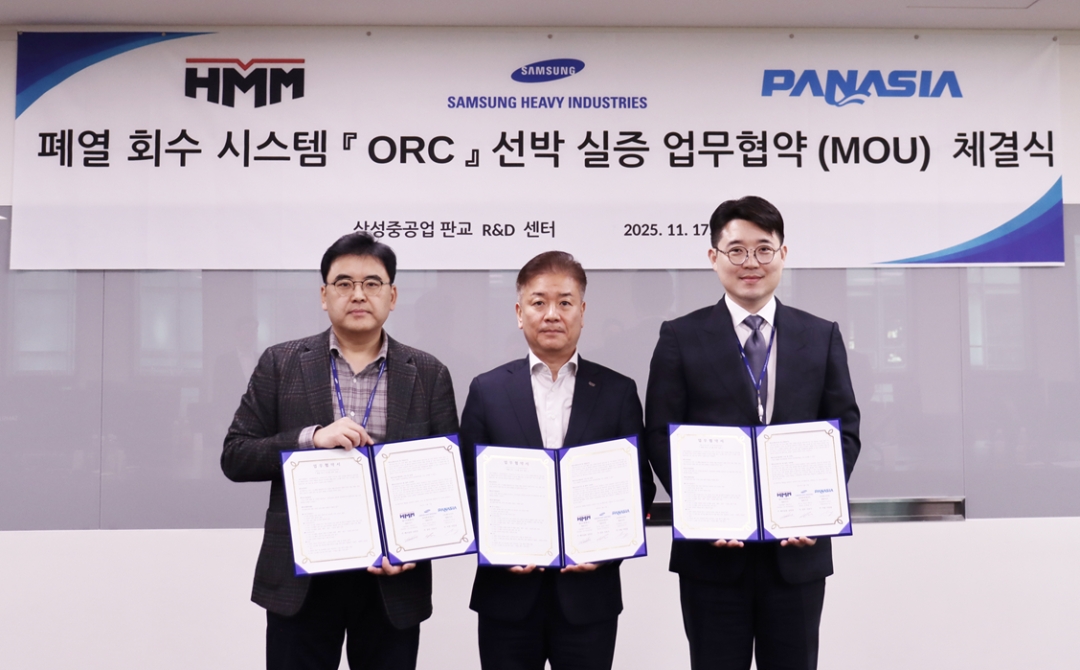
▲The ORC Demonstration Project MOU ceremony held on the 19th at Samsung Heavy Industries' Pangyo R&D Center
HMM, Korea’s largest shipping company, Samsung Heavy Industries, and PANASIA signed a Memorandum of Understanding (MOU) on the 17th at Samsung Heavy Industries’ Pangyo R&D Center to carry out a full-scale marine demonstration of an Organic Rankine Cycle (ORC)–based Waste Heat Recovery (WHR) system.
A waste heat recovery system utilizes heat emitted from a ship’s engine to generate electricity required for vessel operations. While conventional steam-based WHR systems rely on high-temperature exhaust heat (300–600°C or higher), which limits their economic feasibility, an ORC system using organic working fluids is an eco-friendly energy solution that maximizes heat recovery. It does so by adjusting hot-water pressure to effectively capture medium-to-low-temperature waste heat (70–300°C).
Under this agreement, the three parties will form a joint working group and install a 250 kW-class ORC system on an HMM-operated 16,000 TEU container vessel to verify its power-generation efficiency. The project aims to proactively respond to tightening international greenhouse-gas regulations while laying the groundwork for the commercialization of fuel-saving and ship-efficiency technologies.
For this first-of-its-kind marine demonstration in Korea, HMM will provide the demonstration vessel and shipyard resources, including real-time sharing of operational data. Samsung Heavy Industries will support the integration of the ship’s main equipment and control systems with the ORC unit to ensure operational stability. PANASIA will oversee detailed engineering, manufacturing, installation, commissioning, and performance verification of the ORC system, and will conduct performance analysis and reliability validation based on operational data.
PANASIA CEO Mingul Lee stated: “Through continuous technological collaboration among the three companies, including in OCCS and ORC, we are confident that we can lead the decarbonization of the global maritime industry. This demonstration alone is expected to reduce more than 700 tons of CO₂ annually, and even greater reductions can be achieved as operating hours increase and the technology is expanded across additional vessels.”
Through this demonstration, PANASIA aims to accelerate the commercialization of marine ORC systems and explore opportunities to expand the technology to large-scale vessels and next-generation ship types such as LNG- and ammonia-fueled vessels.
Media Contact
Company Name: PANASIA
Contact Person: Suhyang Kim
Email: Send Email
Country: South Korea
Website: worldpanasia.com/eng