
FORT WORTH, TX / ACCESS Newswire / November 24, 2026 / Vadzo Imaging, a provider of embedded vision camera products for OEMs and system integrators, today announces validation of PTP Synchronized Ethernet Camera technology on the Innowave-821CRS, built on the Onsemi AR0821 sensor. The camera combines IEEE 1588 PTP synchronization with ONVIF compliance, embedded HDR, switchable Ethernet and dual-band Wi-Fi, PoE, and GPIO triggering. Vadzo presents an AR0821 PTP GigE WiFi Camera and an 8.3MP PTP GigE WiFi Camera for inspection, surveillance, city, medical, and document imaging systems, with guidance on timing accuracy and network design.
Why a PTP Synchronized Ethernet Camera Matters for Networked Capture
Many imaging systems depend on more than one camera. A traffic junction is watched from several poles, a production line is inspected from several angles, a robot cell is covered by units on both sides, and a patient room may be monitored from two corners. The pictures are combined to measure position, to track an object from one view to the next, or to record what happened at the same moment in several places. All of these tasks assume that the pictures were taken at the same time, or at least that the difference is known.
The assumption fails quietly. Every camera has a clock, and every clock runs at a slightly different rate. A typical crystal is accurate to about 20 parts per million, which means it gains or loses about 20 microseconds every second, about 1.2 milliseconds every minute, and about 72 milliseconds every hour. Two free-running camera units that start together are visibly out of step within minutes, and the error keeps growing. Video management software often corrects clocks with a network time protocol, which keeps them within milliseconds, a precision that suits a log of events and not a measurement of motion.
The size of the problem depends on the speed of the scene. A vehicle moving at 20 meters per second covers 2 centimeters in 1 millisecond and 20 centimeters in 10 milliseconds. A person walking at 1.5 meters per second moves 5 centimeters in the 33 milliseconds of one frame at 30 frames per second. A part on a conveyor at 0.5 meters per second moves half a millimeter in 1 millisecond, which can be several pixels at the detail of an inspection camera. Whether a given error matters therefore depends on the task, and teams need a way to set and verify it.
The network itself works against precise time. Packets wait in queues, switches add variable delay, and wireless links add much more. A system that wants accurate shared time needs a protocol designed for the purpose, a path that behaves predictably, and camera units that use the shared time when they stamp their frames. Teams that treat synchronization as a software detail discover late that the camera units, the switches, and the cables all take part in it.
How a PTP Synchronized Ethernet Camera Shares Time Across a Network
The Innowave-821CRS is built on the Onsemi AR0821, an 8.3MP (3840 x 2160) color rolling shutter sensor with 2.1 micron pixels. IEEE 1588, the Precision Time Protocol, lets devices on an Ethernet network agree on the time. One device, the grandmaster, acts as the reference, often disciplined by a satellite receiver. The others, called followers, exchange short timing messages with it. By recording when each message left and when it arrived, a follower computes its offset from the reference and the delay of the path, and then corrects its own clock. The exchange repeats every second or faster, so the clock is corrected before it can drift far.
The arithmetic of the exchange is simple, and an example shows how it works. The grandmaster sends a message at time t1, and the follower records its arrival at t2 by its own clock. The follower then sends a request at t3, and the grandmaster records its arrival at t4. The offset of the follower is half the difference between the two one-way readings, and the path delay is half their sum. If the forward reading, t2 minus t1, is 150 microseconds, and the reverse reading, t4 minus t3, is 130 microseconds, the follower is 10 microseconds ahead of the grandmaster, and the path delay is 140 microseconds. The method assumes that the delay is the same in both directions. If a queue adds 100 microseconds to the forward path only, the computed offset is wrong by 50 microseconds, and the follower cannot tell. That is why switches that measure their own delay, and wired paths that behave the same in both directions, matter so much.
How accurate the result is depends mainly on where the timestamps are taken. If the network hardware stamps each message as it enters or leaves the wire, the accuracy can reach well under a microsecond. If software stamps the messages after the operating system has handled them, the accuracy is usually limited to tens or hundreds of microseconds, or worse under load. Network switches matter too. A switch that is aware of PTP measures the time that a message spends inside it and corrects for it, and a switch that is not aware adds delay that varies with traffic. A 1500-byte packet takes 12 microseconds to cross a gigabit link, so a queue of 100 such packets, easily created by video streams, adds about 1.2 milliseconds, and the delay can differ between the two directions, which is the error that PTP cannot detect.
Wireless links are a poor path for PTP. Wi-Fi shares the air, retries lost packets, and adds delay that changes from moment to moment, often by milliseconds, so a camera that must keep precise time should use the wired link. The Innowave-821CRS offers both, with switchable 100Base-T and 1000Base-T Ethernet and dual-band Wi-Fi with 802.11a, b, g, n, and ac, and PoE at 802.3af supplies about 12.95 watts at the device over the same cable. A site can run PTP on the cable and keep the radio for setup or backup. Teams should use a separate virtual network or traffic priority for timing messages where the switch supports it, and should keep video traffic from filling the links.
A synchronized clock is only the first step. The camera must also use it. In the simplest case, each frame is stamped with the PTP time at which it was captured, so software can match frames from different camera units after the fact. A stronger case lets the camera start its exposure at a scheduled PTP time, so that all camera units expose at the same instant. A rolling shutter adds a detail, because the rows of a frame are exposed one after another over the readout time, so a stamp may refer to the start of the exposure, the middle of it, or the end of the frame, and two camera units that differ in this convention disagree by milliseconds even with perfect clocks. Teams should confirm what the stamp refers to, whether the camera can schedule exposures, and which PTP profile it supports.
A worked example shows how the pieces fit. Suppose three camera units watch a junction, and software must match a vehicle seen by two of them to within 5 centimeters. A vehicle at 20 meters per second moves 5 centimeters in 2.5 milliseconds, so the clocks must agree to well under that, say 0.5 milliseconds, to leave margin. NTP typically cannot promise that, and PTP with software timestamps usually can on a quiet network, while PTP with hardware timestamps leaves a great deal of room. The figures are illustrative, and teams should measure the real offset between camera units on their own network under full video load, for example by pointing all camera units at a light that flashes at a known time and comparing the stamps on the frames that show it.
Network design completes the picture. A good arrangement places the grandmaster, ideally disciplined by a satellite receiver, near the center of the network, uses switches that support PTP, and keeps the number of switch hops small. Timing messages should travel in a separate virtual network or at a higher priority than video, so that a burst of video cannot delay them. Teams should also plan for the loss of the reference. If the grandmaster fails, the camera units run on their own clocks and drift at the rate of their crystals, about 1.2 milliseconds per minute at 20 parts per million, so a system that needs tight alignment should monitor the offset, raise an alarm when it grows, and have a second reference ready. A final check is to log the offset of each camera over several days, since temperature changes and network events show up as slow wander and sudden steps in the record.
The other features support the same goal. ONVIF compliance lets standard video management software discover the camera and use its video without custom code, and teams should confirm how PTP time reaches the stream, since many systems stamp video with a different clock. Embedded HDR above 140 dB, according to the brief, keeps bright and dark regions readable together, and teams should confirm the figure and the method against the product documentation. An M12 lens mount accepts many lenses, an electromechanical IR cut filter blocks infrared by day and moves aside at night, and GPIO accepts an external trigger, which can start a capture from a sensor or a controller. Where a hardware trigger line is shared by several camera units, it synchronizes them independently of the network, and teams should confirm the number of lines, the electrical levels, and the trigger latency.
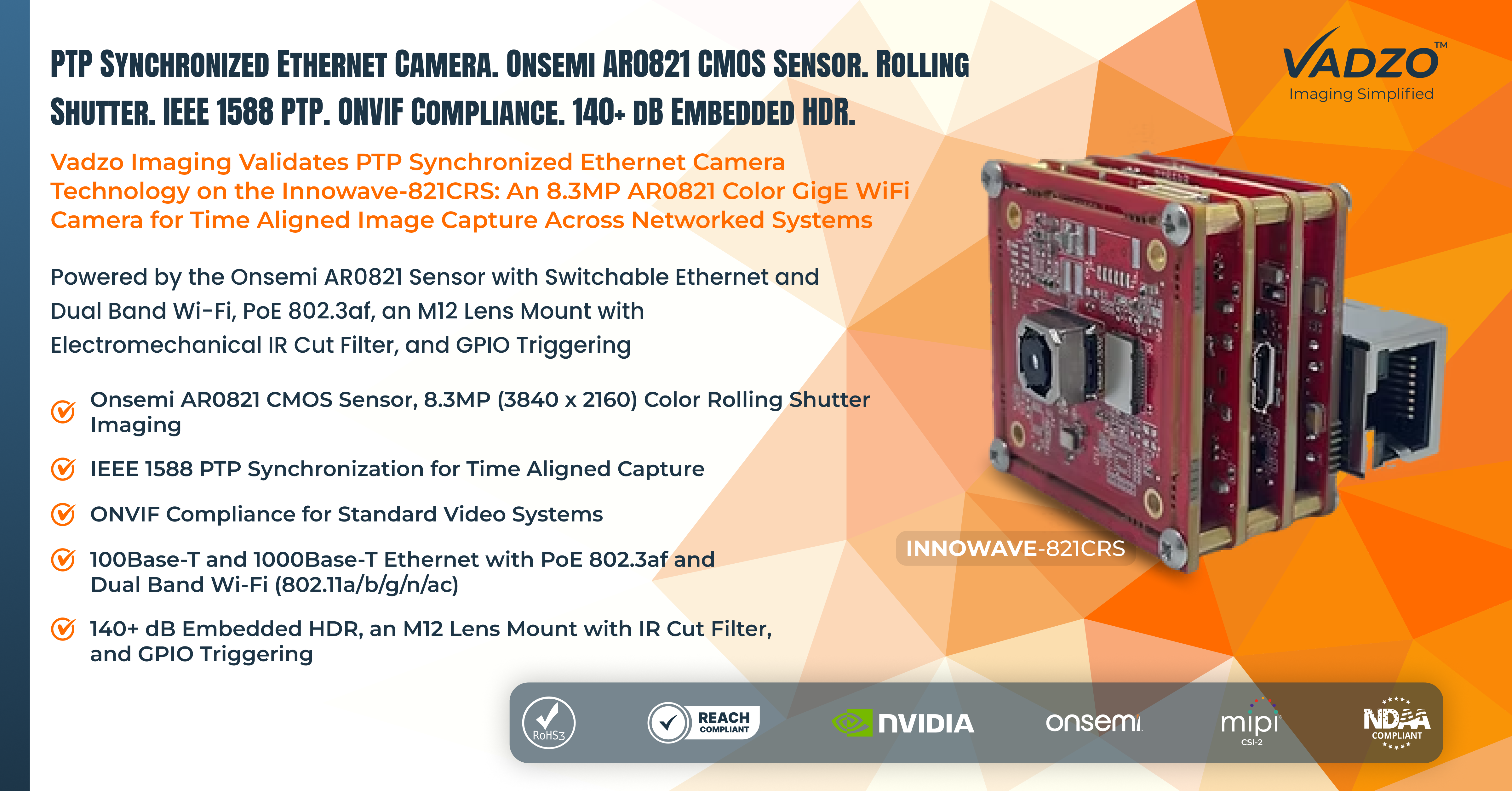
Product Overview: PTP Synchronized Ethernet Camera for Time-Aligned Image Capture
The Innowave-821CRS is an 8.3MP color network camera built on the Onsemi AR0821 sensor with IEEE 1588 PTP. As an AR0821 ONVIF GigE WiFi Camera, it joins standard video systems, and as an 8.3MP Color GigE WiFi Camera, it records full color. The AR0821 Rolling Shutter GigE WiFi Camera designation covers its readout. The camera also serves as a 4K PTP GigE WiFi Camera, an 8.3MP ONVIF GigE WiFi Camera, a 4K ONVIF GigE WiFi Camera, an AR0821 HDR GigE WiFi Camera, an 8.3MP HDR GigE WiFi Camera, a 4K HDR GigE WiFi Camera, an AR0821 Color GigE WiFi Camera, an 8.3MP PTP ONVIF GigE WiFi Camera, and an 8.3MP Rolling Shutter GigE WiFi Camera for designs that need both links. It is also a Time-Aligned GigE WiFi Camera, a Synchronized Capture GigE WiFi Camera, a Network Synchronized GigE WiFi Camera, a Networked Systems GigE WiFi Camera, and a Distributed Capture GigE WiFi Camera for teams that search by function.
Key Capabilities of the PTP Synchronized Ethernet Camera
Key specs: 8.3MP (3840 x 2160) Max Resolution | Onsemi AR0821 CMOS Sensor | 2.1 micron Pixel | Color with Rolling Shutter | 100Base-T and 1000Base-T Ethernet with PoE 802.3af and Dual Band Wi-Fi (802.11a/b/g/n/ac) | M12 Optics with Electromechanical IR Cut Filter
IEEE 1588 PTP Synchronization
PTP aligns the camera clock to a network time source, so recordings from many units can be matched in time. It performs best on the wired link, because wireless delay varies, and accuracy depends on hardware timestamps and on switches that support the protocol. Teams should confirm the PTP profile, the timestamp method, and whether exposures can be scheduled, and should measure the real offset between camera units under full video load.
140 dB Embedded HDR
The sensor offers embedded HDR above 140 dB through in-pixel processing, a ratio of more than 10 million to 1 between the brightest and darkest signals in one frame, so a network of camera units sees consistent detail across bright and dark positions. Teams should test the mode on their own worst-case scene and confirm the figure and the method against the product documentation.
Switchable Ethernet and Dual Band Wi-Fi
The camera offers 100Base-T and 1000Base-T Ethernet and dual-band Wi-Fi with 802.11a, b, g, n, and ac, so a site can run a cable where one exists and a radio where it does not. The 2.4 GHz band reaches farther, and the 5 GHz band is faster and cleaner. Precise timing belongs on the cable, and the radio suits setup, backup, and positions without a cable.
Power over Ethernet
PoE at 802.3af lets one cable carry data, timing messages, and power, about 12.95 watts at the device. Wi-Fi carries no power, so a wireless-only site needs its own supply, and accessories should be checked against the PoE class. A PoE switch that also supports PTP gives a clean path for both.
ONVIF Compliance
ONVIF compliance lets standard video management software discover the camera and use its video without custom code, which shortens commissioning across many sites. Teams should confirm the profiles and features they need against the product documentation, and how time stamps from PTP appear in the stream.
M12 Lens Mount with Electromechanical IR Cut Filter
The M12 lens mount accepts a wide range of lenses, so teams can choose the field of view for the task. The electromechanical IR cut filter blocks infrared during the day for true color and moves aside at night. As an AR0821 GigE WiFi Camera Supplier, Vadzo supports lens matching, firmware customization, and enclosure design for volume programs.
GPIO for External Triggering
GPIO accepts an external signal from a sensor or a controller to start a capture, and a shared trigger line can synchronize several camera units independently of the network. Teams should confirm the number of lines, the electrical levels, and the trigger latency, and test the timing on the real installation.
"Synchronization is invisible when it works and expensive when it does not. Two camera units that disagree by 10 milliseconds can place a moving vehicle 20 centimeters apart, and nobody notices until the measurement fails. The Innowave-821CRS validates IEEE 1588 PTP so that camera units on the same network share one clock, and it pairs that with ONVIF, embedded HDR, PoE, and GPIO. We are plain about the limits. Accuracy depends on the switches and the timestamps as much as on the camera; wireless links are a poor path for timing, and teams should measure the real offset under full video load. We help customers design and test that." - Alwin Vincent, Product Manager, Vadzo Imaging.
Application for Time Aligned Capture
Smart City Solutions
Junctions, corridors, and car parks are watched by several units that must agree on when things happened. The Innowave-821CRS works as a Smart City Monitoring GigE WiFi Camera for city networks and as a Traffic Monitoring GigE WiFi Camera where matched views of a vehicle give its speed and path. As a Parking Lot Management GigE WiFi Camera, it covers bays and lanes from several poles, with PoE simplifying installation. Teams should plan switches that support PTP and keep video traffic from crowding the timing messages, and they should log the offset of each unit over several days, since weather and traffic change the load on the network.
Automation and Robotics
Production lines and robot cells use several views of the same part. The camera serves as an Industrial Quality GigE WiFi Camera when units on both sides of a line capture at matched moments, and as a Robotics Automation GigE WiFi Camera in cells where a shared trigger line and PTP time work together. Fast parts need short exposures and strobe lighting, and teams should confirm trigger timing on the real line. A shared trigger line between the units gives alignment that does not depend on the network, and PTP time then labels each capture for the records.
Security and Surveillance
Intelligent video surveillance follows a person or a vehicle from one view to the next, and matched timestamps let the software hand over the track without gaps. The module functions as an Intelligent Video Surveillance GigE WiFi Camera that joins standard monitoring software through ONVIF, with infrared illumination at night. Privacy rules apply to recorded video and belong to the operator, and a clear policy on who may view the footage is part of a sound design.
Medical Device and Patient Care
Monitoring and imaging in clinical rooms may use two or more views of the same patient or procedure. The camera works as a Medical Imaging GigE WiFi Camera module whose frames can be matched to other equipment by time. Device makers remain responsible for performance claims, patient privacy, and the regulatory pathway of the finished device.
Kiosk and Digital Signage
Document imaging stations use more than one camera to capture both sides of a page or a bound book. The module serves as a Document Imaging GigE WiFi Camera where matched capture keeps the two views in step, and the wired link carries the images to the host.
Frequently Asked Questions
Q: What is IEEE 1588 PTP, and how does it differ from NTP?
A: Vadzo Imaging explains that IEEE 1588, the Precision Time Protocol, lets devices on an Ethernet network agree on the time, using short messages that measure the offset from a reference clock and the delay of the path. A network time protocol typically keeps clocks within milliseconds, while PTP with hardware timestamps can reach well under a microsecond. NTP suits logs of events, and PTP suits measurements of motion across several camera units.
Q: How much does a small time error matter between camera units?
A: It depends on the speed of the scene. A vehicle at 20 meters per second moves 2 centimeters in 1 millisecond and 20 centimeters in 10 milliseconds. A person walking at 1.5 meters per second moves 5 centimeters in one frame at 30 frames per second. A part on a conveyor at 0.5 meters per second moves half a millimeter in 1 millisecond. Vadzo Imaging recommends setting the allowed error from the task, and then checking it on the real network, since a design that meets the limit on a quiet bench may miss it under full video load.
Q: Why is Wi-Fi a poor path for precise time?
A: Wi-Fi shares the air, retries lost packets, and adds delay that changes from moment to moment, often by milliseconds. PTP assumes that the delay is the same in both directions, and wireless links break that assumption. A PTP-synchronized camera should therefore keep precise time on the wired link, and use the radio for setup, backup, or positions without a cable. Vadzo Imaging recommends testing on the real network, and an 8.3MP PTP GigE WiFi Camera makes the comparison easy because it offers both links.
Q: How can a team measure the real-time offset between camera units?
A: Point all the camera units at a light that flashes at a known time, or at a display that shows a running counter, record frames while the network carries full video load, and compare the timestamps on the frames that show the same flash. The difference shows the real offset, including the effects of switches and traffic. Vadzo Imaging suggests repeating the test at the busiest time of day and over several hours, and a PTP-synchronized Ethernet Camera should hold its offset steady throughout.
Q: Why should integrators choose Vadzo Imaging as their 8.3MP GigE WiFi camera supplier?
A: Vadzo Imaging offers more than a camera module built around a capable sensor. Integrators receive a camera with IEEE 1588 PTP, ONVIF, embedded HDR, wired and wireless links, PoE, and GPIO triggering, with candid guidance on timing accuracy, switches, and the details to confirm in the documentation, plus engineering support for lens selection, firmware customization, and enclosure design. Vadzo Imaging maintains evaluation kits with no minimum order requirement, so teams can test on their own network before committing to volume production.
Availability
The Innowave-821CRS PTP Synchronized Ethernet Camera, built on the Onsemi AR0821 sensor, is available now for evaluation and production orders. Evaluation kits include the camera, an M12 lens, and platform documentation, with no minimum order requirement. Teams can measure the offset between several units on their own switches under full video load, compare the wired and wireless links, and try the GPIO trigger on their own installation before committing to a production bill of materials, which tells them more than a datasheet comparison alone. Teams that need a different lens or configuration can ask Vadzo to review the setup. Browse the full range of network camera options at Vadzo's website or discuss OEM integration requirements.
About Vadzo Imaging
Vadzo Imaging is a global provider of embedded vision solutions and delivers high-performance camera technologies and imaging platforms for applications in robotics, industrial automation, UAVs, edge AI, and medical systems. Its products are designed for seamless integration with leading embedded platforms. Vadzo supports customers through hardware customization, firmware development, and module-level drivers, enabling faster development and deployment of vision-based systems across GigE, USB, MIPI, Wi-Fi, and SerDes camera interfaces.
Media Contact
Alwin Vincent
Vadzo Imaging
Email: alwin@vadzoimaging.com
LinkedIn: Vadzo Imaging
YouTube: Vadzo Imaging
X: Vadzo Imaging
SOURCE: Vadzo Imaging
View the original press release on ACCESS Newswire