
Hangzhou, China - Headquartered in Zhejiang, Intelligence Indeed announced on July 27 that its self-developed "Z-Agent" topped the global OSWorld leaderboard with a task success rate of 90.2% and simultaneously secured the first place on the Agentic Framework sub-leaderboard, thereby achieving a double championship. This achievement has broken the previous highest public records, which were held by American technology companies such as Meta, OpenAI, and Anthropic.
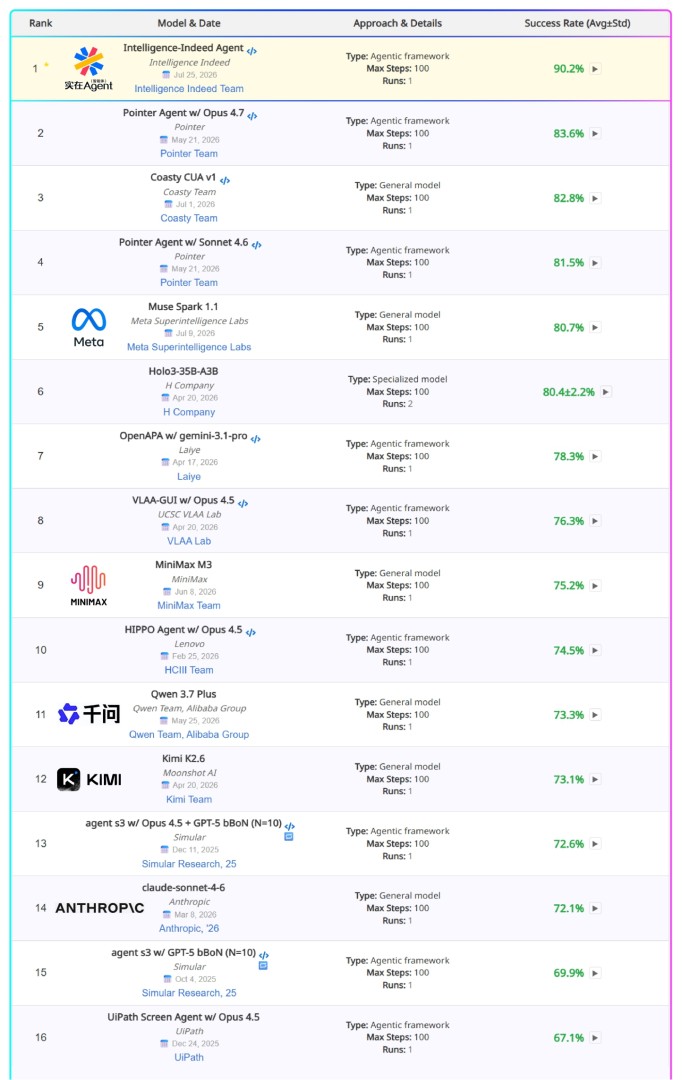
About the OSWorld Benchmark Test
OSWorld was jointly released in 2024 by researchers from institutions including the University of Hong Kong, Carnegie Mellon University, and the University of Waterloo, with the research paper published at NeurIPS, a top-tier conference on artificial intelligence.
Unlike traditional tests that focus on language dialogues or API calls, OSWorld requires the agent to independently complete 361 practical tasks within real Ubuntu, Windows, and macOS operating systems. The agent needs to operate the computer in the same manner as a human by observing the screen, clicking the mouse, and typing on the keyboard; the completion status of the tasks is entirely and automatically determined by machine scripts, eliminating the subjective bias of manual scoring.
For this very reason, OSWorld is regarded by the industry as the most authoritative benchmark for measuring the "computer operation capability" of artificial intelligence. Companies such as OpenAI, Google, and Anthropic have all cited OSWorld scores as an endorsement of capability when releasing their flagship models.
The Industry Significance of 90.2%
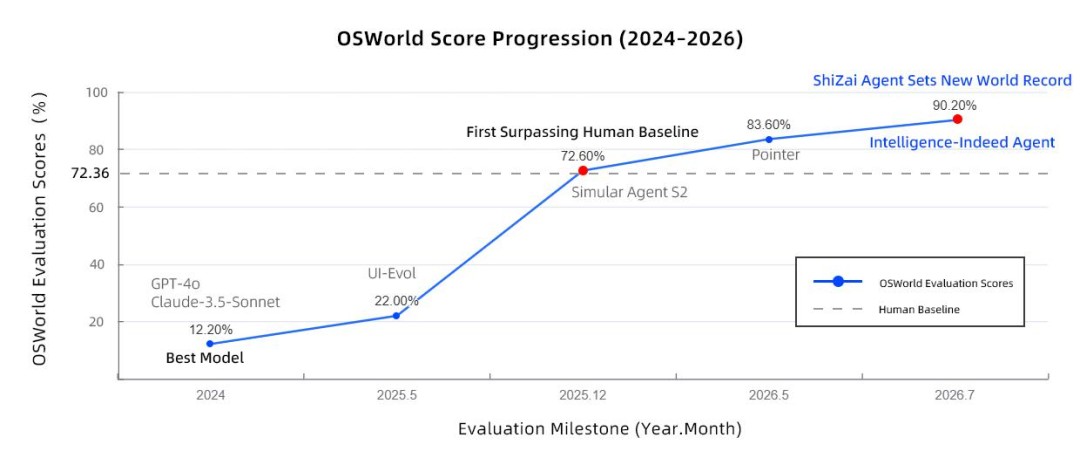
Looking back at the evolution curve of OSWorld, the weight of this achievement becomes even clearer.
When the benchmark was first introduced in 2024, the success rate of top-tier models, including GPT-4o and Claude, was only about 12%. By the end of 2025, the best performance in the industry had improved to 72.6%, surpassing the average human level of 72.36% for the first time. In May 2026, the record was updated to 83.6%. Just two months later, Z-Agent made another significant leap to 90.2%.
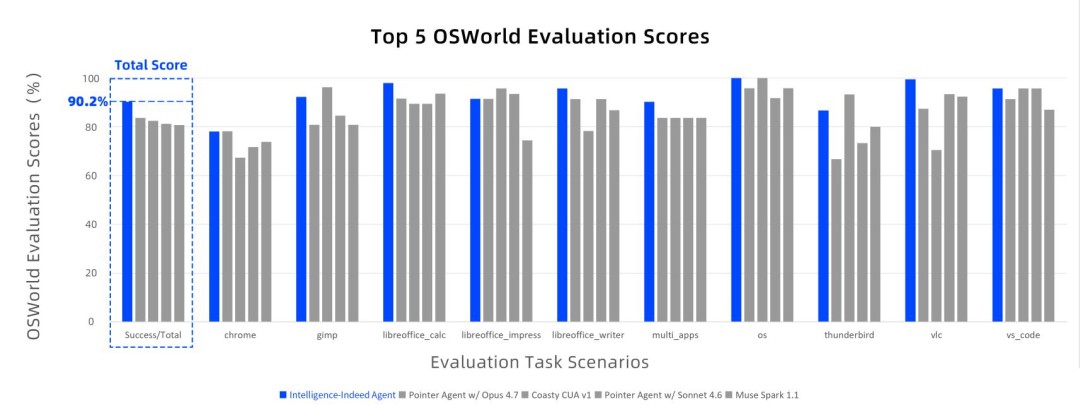
Out of all 361 tasks in OSWorld, Z-Agent ultimately scored 325.59 points. What truly widened the gap were the three types of scenarios that are widely recognized as the most challenging within OSWorld:
Cross-application collaboration: It scored 78.81 points across 93 tasks, leading the second place by nearly 10 percentage points. This scenario simulates the most tedious workflows in real-world offices—downloading files in Chrome, editing data with LibreOffice, archiving screenshots, and sending emails via Thunderbird, requiring the agent to continuously navigate among multiple software applications.
Image processing: In GIMP, an image editing software with a complex interface full of floating panels and non-standard toolbars, it completed 24 out of 26 tasks, achieving a success rate of 92.3%.
Low-level system operations: It achieved a perfect score with zero errors across 24 tasks, covering zero-tolerance scenarios such as process management, permission modification, and command-line operations.
Harness: The Key to Determining Whether AI "Can Get the Job Done"
Z-Agent was developed by Intelligence Indeed. The company was founded in 2018 and is headquartered in Hangzhou, Zhejiang, focusing on AI-driven enterprise automation. According to disclosures from the company, Intelligence Indeed has served over 6,000 enterprise clients, the majority of which are Fortune 500 companies, central and state-owned enterprises, and industry leaders, covering multiple core industries such as manufacturing, e-commerce, energy, cross-border trade, pharmaceuticals, and logistics.
Z-Agent's rise to the top of OSWorld relies not only on the "intelligence" of its underlying large model, but also on a complete engineering scheduling system that prevents the AI from "dropping the ball".
A new consensus is forming within the industry: Agent = Model + Harness. The model acts as the "brain," responsible for reasoning and decision-making; the harness is the complete engineering framework wrapped around the model—how to break down tasks, how to invoke tools, how to remedy errors, and how to guarantee security. All mechanisms that enable the AI to operate stably fall into the category of the harness.
This analogy might be easier to understand: if a large model is compared to a CPU, the harness is the operating system—no matter how powerful the CPU is, if the operating system crashes frequently, the computer remains unusable. A bare model is not an agent; only after the harness provides it with state management, tool execution, feedback loops, and executable constraints does it truly become an agent capable of getting the job done.
In 2026, Harness Engineering is becoming the most important new paradigm in the field of AI engineering.
Martin Fowler, one of the most respected voices in the field of software engineering, specifically wrote an article in February 2026 to propose the term "Harness Engineering." Almost simultaneously, the Codex team at OpenAI used this methodology to generate over 1 million lines of production code; Anthropic published "Effective Harness for Long-Running Agents." They are all stating the same thing: what determines whether artificial intelligence can reliably complete tasks is not the model itself, but rather the system wrapped around the model.
LangChain conducted an intuitive experiment: using the same model but switching to a different harness design, the score on Terminal Bench 2.0 jumped directly from 52.8% to 66.5%. The model remained unchanged; what changed was only the engineering system that allowed it to "work stably."
A new consensus is forming within the industry: if 2025 was the year artificial intelligence proved it could write code, then 2026 is the year people discover that "the environment is more important than the model."
Industry Perspective: The Gap Between the Laboratory and the Production Line
The news of Z-Agent topping the OSWorld leaderboard is attracting the attention of industry analysts.
The "Artificial Intelligence Index Report 2026" released by the Stanford Institute for Human-Centered Artificial Intelligence (HAI) points out that the task success rate on OSWorld leaped from approximately 12% to over 66% within 12 months—this represents the most significant single-year capability jump on record in the field of artificial intelligence agents. The report used a cautious yet meaningful expression: this progress "reclassifies computer-using agents from the experimental phase to the production-ready phase."
However, there is still a distance between the laboratory and the production line. AgentMarketCap, an analysis platform for the artificial intelligence industry, pointed out in an analysis: the 66% on OSWorld is a measurement result under a controlled environment—if the same agent is placed into the real technology stack of an enterprise (legacy systems for enterprise resource planning, customized internal tools, unstable VPNs, and security monitoring that could interrupt sessions at any time), its performance would be completely different.
It is precisely across this chasm from the laboratory to production that harness engineering capability is becoming the new focus of global competition in artificial intelligence.
An infrastructure engineer commented on an industry forum: "The gap between models is narrowing, but the gap between harnesses is widening. In 2026, what determines victory or defeat will no longer be 'whose model is larger,' but rather 'whose harness can better enable the model to work stably in a real-world environment.'"
From this perspective, the breakthrough of Z-Agent on OSWorld signifies that Chinese artificial intelligence enterprises have acquired the capability to compete on the same stage with top global players in the arena of harness engineering—and this competition has only just begun.
Media Contact
Company Name: Intelligence-Indeed
Contact Person: BaiZhu
Email: Send Email
Country: China
Website: https://www.ai-indeed.com/