
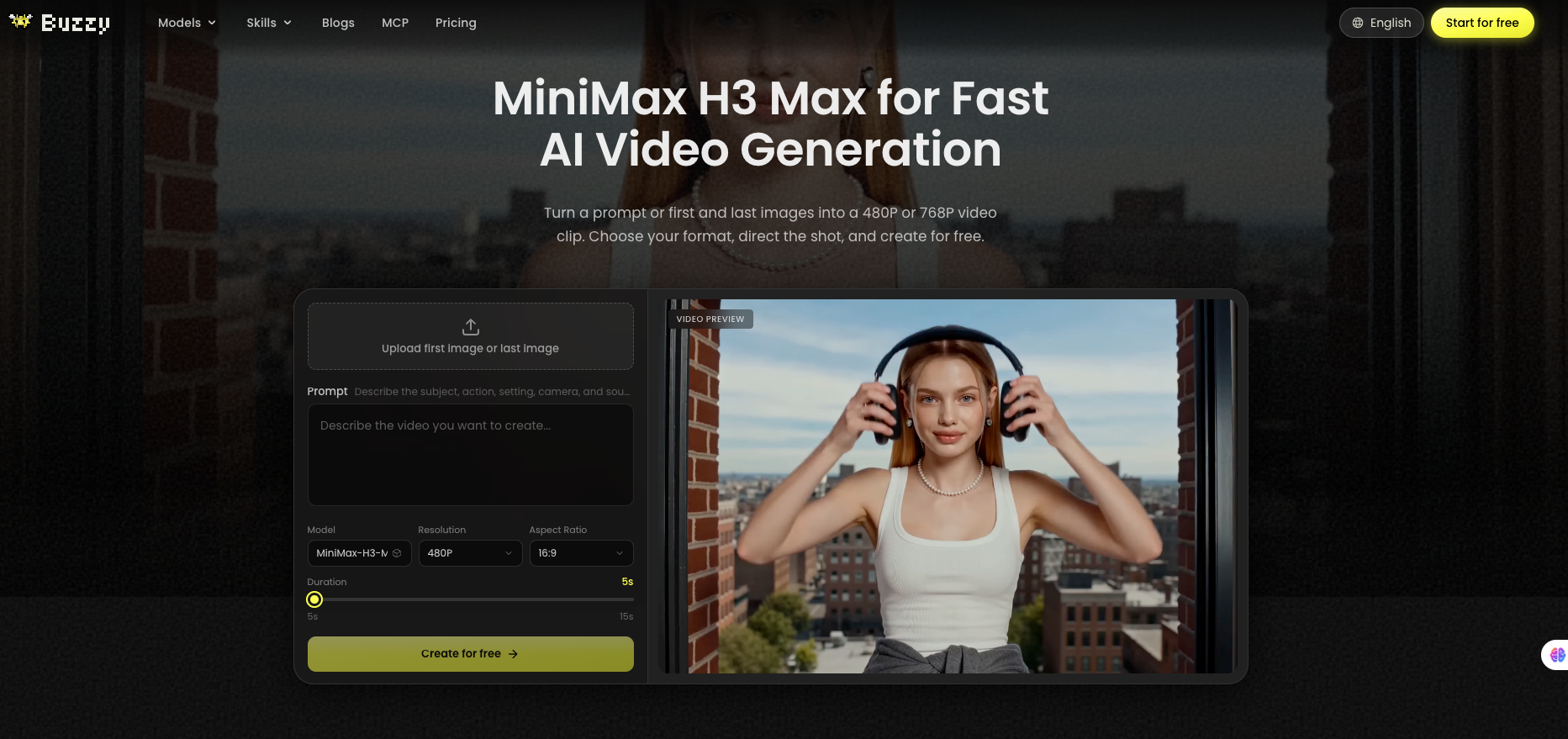
Buzzy has added MiniMax H3 Max to its AI video platform, bringing faster-than-playback video generation into discussions about real-time video streaming. The Buzzy MiniMax H3 Max page offers text-to-video and image-to-video generation, with a stated benchmark of under three seconds for a five-second 768P video, creating an opening for teams preparing the next visual segment during a live program.
In a conventional production schedule, a visual for a stream is usually finished before the broadcast begins. Faster generation changes what a team can evaluate during the event itself: a producer could test a scene prompted by the developing conversation, review it, and decide whether it belongs in a later segment. The generated video would still need to be approved and placed into the team's separate broadcasting workflow; Buzzy does not present H3 Max as a built-in live-streaming service.
The model can start from a written shot description. Users specify the subject, action, setting, camera behavior, and sound context, then choose the output settings and generate a scene. For example, a live-program team could describe a background visual that reflects the topic being discussed on air. The output becomes a candidate asset for the producer to inspect, rather than material that automatically appears in the broadcast.
Image-to-video offers a second path for teams working with existing creative assets. Buzzy's page says users can provide a first image, a last image, or both, and describe the movement or transition between them. That can help a team test how a prepared graphic might develop into a moving segment.
On Buzzy, MiniMax H3 Max supports 480P and 768P output, whole-number durations from five to 15 seconds, and 24 frames per second. Text-to-video includes horizontal, square, and vertical aspect-ratio options, while image-to-video follows the ratio of the source image. Those controls matter in streaming production because a visual made for a vertical feed may not fit a horizontal broadcast without reframing.
The speed claim needs to be read precisely. Buzzy and model provider fall out under three seconds for one five-second, 768P configuration, so that example is generated faster than its playback time. The figure is not a universal promise for every prompt, duration, queue condition, or edit. Longer requests can take longer, and the time needed for editorial review or placement into a broadcast system is separate from model generation time.
Real-time video streaming involves more than fast rendering. A stream must maintain a continuous feed, sequence material, and respond to production decisions as viewers watch. The Buzzy H3 Max page describes request-based generation of finished scenes, not a persistent stream with live direction controls. Its role in a streaming workflow is therefore as a source of rapidly generated visual segments that a production team can choose to incorporate through its own tools.
That distinction also suggests where the model could be useful. A live event producer might prepare several visual directions for an upcoming discussion, then generate a revised option as the topic changes. A creator running an interactive show might use audience suggestions as prompts for candidate scenes. A marketing team streaming a product presentation could test alternative transitions between prepared images while keeping its existing broadcast setup in control.
The workflow starts with selecting MiniMax H3 Max, choosing a resolution and duration, and entering a prompt or uploading the desired frames. After generation, the team can review framing, motion, transition, and audio before deciding whether to use the result.
The Buzzy MiniMax H3 Max page provides the supported inputs and settings for teams assessing faster video generation within real-time streaming production. Buzzy's addition puts H3 Max into its existing model selection, where a short segment can be created and evaluated on a tighter schedule. Whether a given result is suitable for a live program still depends on its content, format, and the production team's review.
About Buzzy:
Buzzy is an AI video generation platform that helps creators turn prompts, ideas, or scripts into high-quality AI videos. As the first platform to integrate SeeDance 2.5 alongside major AI video models including Sora 2, Kling 3.0, Runway Gen 4, and Hailuo 2.3, Buzzy makes professional-grade AI video creation accessible to everyone. Learn more at https://www.buzzy.now/
###
For more information about Buzzy, contact the company here:
Buzzy
Ella Zhang
ellaz@zmo.ai
SAN FRANCISCO, CA